
AI Smart Chat
In the right panel of Aino LifeOS, you can chat with AI to analyze notes, generate content, and answer questions. The advantage goes beyond chat: in Edit or Agent mode, AI can read a real vault, call local CLI agents, and return file changes as editor diffs for chunk-by-chunk review.
Where to Start in the App
- Aino Desktop: Click the AI icon in the right sidebar to open the chat panel.
- Configuration: For first use, open Settings → AI. If you use Claude Code or Codex CLI, this page also shows local CLI status and diagnostics.
- Beginner path: Start with Ask mode, then use Edit mode for the current note. Use Agent mode after you understand the diff review flow.
Configure AI
Before first use, set up your API key:
- Open Settings → AI
- Select a vendor (e.g., Claude, GPT, DeepSeek)
- Enter your API key
- Choose a default model
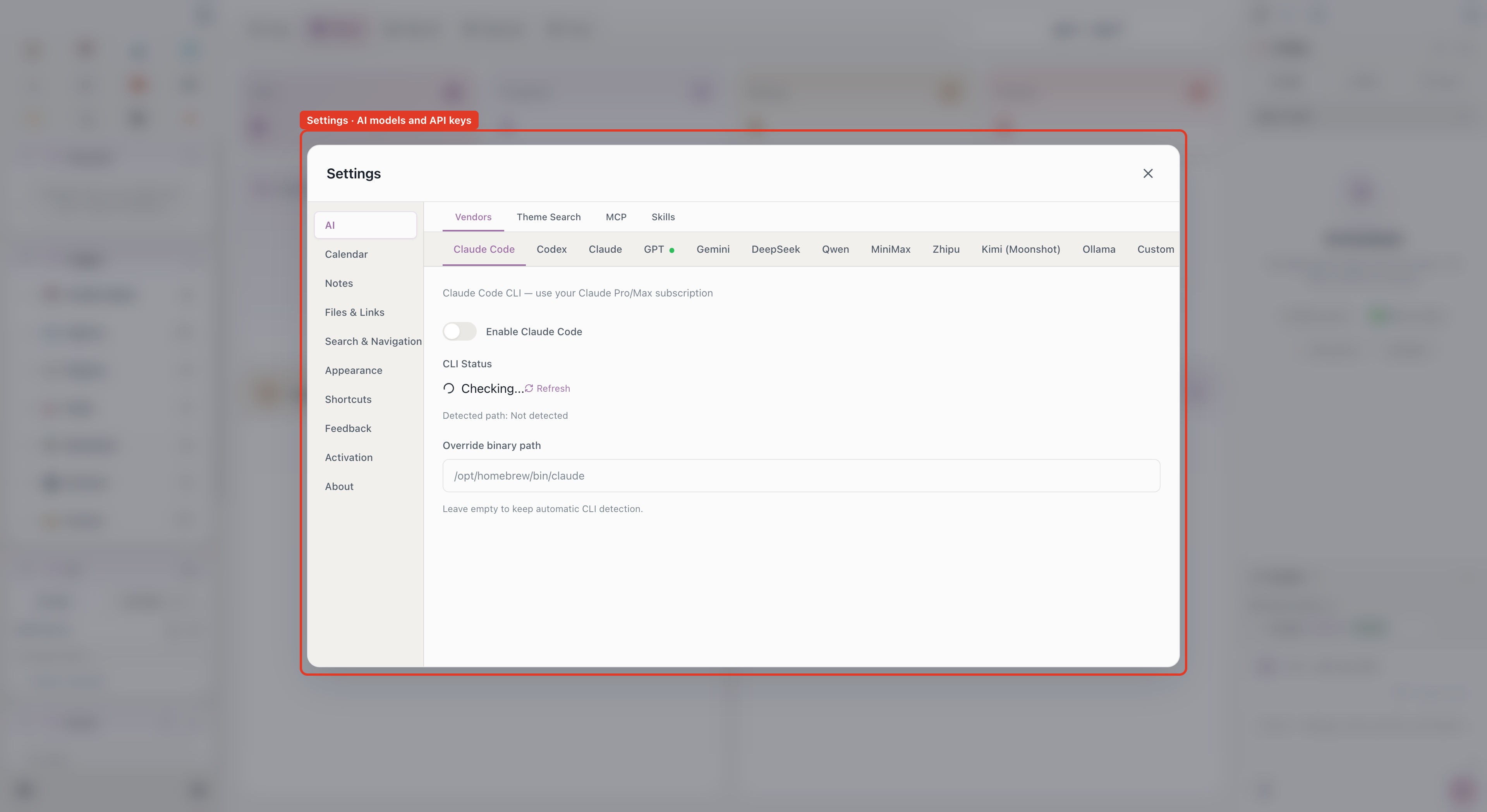
Supported vendors and agents:
For privacy, choose Ollama -- all data is processed locally.
Start a Conversation
Click the right AI panel and type your question. AI replies stream in real-time.
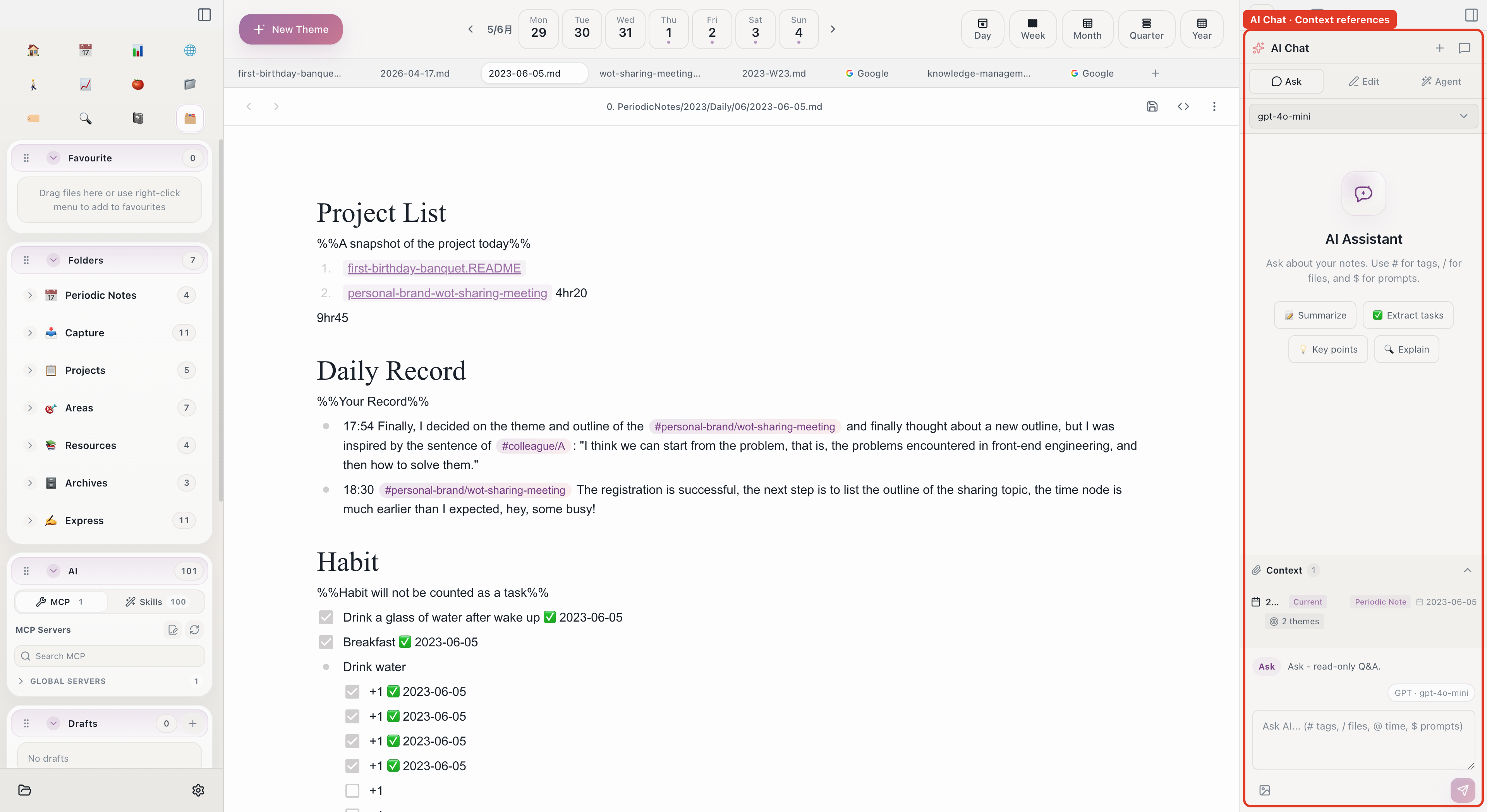
AI Summary
AI Summary uses the same right-side chat panel, and it does not convert your source into a locked proprietary format. The shortest path is:
- Open the note you want to process, or attach one or more notes with
#. - Stay in Ask mode and click the Summary quick action, or ask: “Summarize these materials with key conclusions and next steps.”
- Check the context scope, then continue the conversation, copy the result, or export it as Markdown.
For a selected passage, state that scope explicitly. For a cross-file summary, first limit the evidence with #, @, or current-page context so the model does not have to guess which vault material matters.
Choose an AI Mode
The right AI panel has three modes. A fresh session starts from the safer Edit mode:
If you enable AI control of the current interface, Agent mode can also observe and operate the current Aino interface, including the left sidebar, editor, built-in web pages, and right task panel.
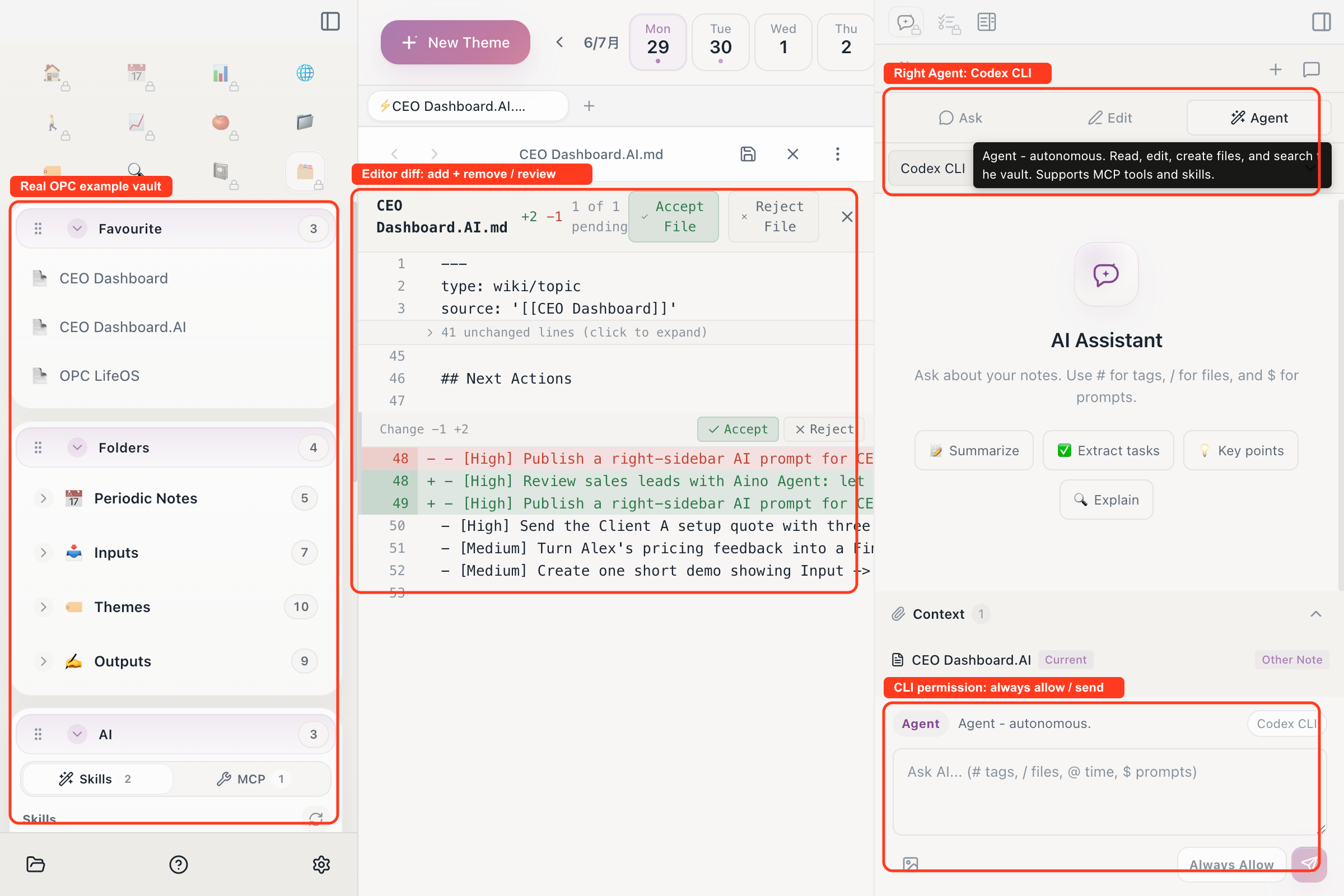
Here is an Agent example from the real OPC LifeOS example vault: the right sidebar uses Codex CLI, the agent reads Sales & Customer material and proposes CEO Dashboard changes, and the editor shows additions and removals as a reviewable diff instead of overwriting the note. You can accept or reject by file or chunk, while CLI permission controls stay in the lower-right input area.
Give AI Your Note Context
This is the most useful AI feature in Aino LifeOS. By default, AI doesn't know your note content. These triggers let AI read your notes:
# to Attach Files
Type # in the input box to open a file picker. Selected notes become AI context.
Steps:
- Type
#in the input box - Search and select note files to attach
- File names appear above the input box
- Type your question and send
Common uses:
- Attach a long article, ask AI to summarize
- Attach project docs, ask AI questions about them
- Attach multiple files for comparative analysis
@ to Select Date Range
Type @ to select a time period. AI automatically reads all notes from that period.
Steps:
- Type
@in the input box - Select start and end dates
- Type your question and send
Common uses:
- "@last week summarize my work this week"
- "@this month analyze my time allocation"
$ to Use Prompt Templates
Type $ to use preset prompts, saving time on repeated instructions.
! to Activate Skills
Type ! to select Skills. A Skill is a SKILL.md file that teaches AI how to handle a class of tasks, such as operating a LifeOS vault, writing a daily report, or running a release workflow.
Skills can live in the current vault's .agents/skills/ directory or in user-level Claude / Codex skill directories. User-level Skills are off by default and can be enabled in Settings → AI → Skills.
Conversation Management
- New conversation -- Click the + button at the top of the panel
- View history -- All conversations are auto-saved; switch back anytime
- Export one message -- Click the export button below a message
- Export selected messages -- Click the select button below a message, select multiple messages, then export
- Export the full conversation -- Click the export button at the top of the panel
- Choose where to save -- Every export opens the system save dialog so you can edit the file name and choose a location; exports use Markdown format
- Send images -- Attach images in conversations (requires vision-capable model)
AI Intelligent Execution (Agent Mode)
Beyond regular chat, Aino LifeOS also supports Agent mode -- AI can not only answer questions but also operate the file system, with file edits routed back into editor diffs for approval.
Start with this workflow:
- Switch the right AI panel to Agent mode.
- Choose an ordinary model, Claude Code, or Codex, then attach the necessary files, date range, or Skill.
- Describe an outcome, for example: “Read this week's project notes, update the project home note, and list the blockers.”
- Review tool permissions, commands, and file diffs. Apply only the changes you approve.
After switching to Agent mode in the right panel, AI can:
Sensitive operations (writing files, executing commands) require your manual confirmation. AI shows what it intends to do before each operation, and you can approve or reject. File edits, whether additions, removals, or rewrites, then go through the diff review flow instead of being silently written.
In Settings → AI → Permissions, you can further control:
- Whether write / update tools are available
- Whether delete-like tools are available
- How many automatic tool rounds an ordinary-model reply may use
These permission switches only affect Aino's built-in ordinary-model and MCP tool flows. CLI agents such as Claude Code and Codex use their own permission prompts. Experimental AI control of the current interface lives in Settings → Experiments.
Agent mode can modify files. We recommend using it in Git-managed projects for easy rollback.
Claude Code / Codex Integration
Aino LifeOS's most powerful AI capability comes from directly reusing local CLI Agents. If you have Claude Code or OpenAI Codex installed on your machine, Aino LifeOS can call them directly with no extra configuration.
Why This Matters
Regular AI chat interfaces can only generate text. Claude Code / Codex are full CLI Agents with capabilities including:
- File read/write -- Read entire project structures, modify any file
- Command execution -- Run build, test, lint, or any terminal command
- Multi-step reasoning -- Autonomously plan and execute complex multi-step tasks
- Long-running tasks -- Keep working until the task is complete, rather than a one-shot reply
- Tool calling -- Use external tools via the MCP protocol
Aino LifeOS serves as a GUI frontend for these CLI agents: the right sidebar starts tasks, manages context and permissions, while the editor displays AI-generated diffs. You can handle coding, debugging, and refactoring, or use the same flow in a business vault to refresh dashboards, complete sales follow-ups, and generate review conclusions.
Automatic Reuse of Local Configuration
Aino LifeOS automatically reads your local CLI Agent configuration:
~/.claude/mcp.json-- MCP server configurations take effect automatically- Existing authentication states are reused directly, no re-login needed
- API keys and model preferences don't need reconfiguration
Typical Usage
- Open a code project or business knowledge vault in Aino LifeOS
- Switch to Agent mode
- Describe your needs in natural language, e.g., "Read Sales & Customer and recent daily notes, then update the CEO Dashboard's Top 3 for this week"
- The AI Agent reads files, plans changes, generates diffs, and waits for your confirmation before writing
Related
- AI Workbench (Experimental) -- Maintain persistent work scenes and inspect run receipts
- AI Organize (Experimental) -- Select content for one organization run
- Configure MCP Servers -- Let AI use external tools
- AI Control of the Current Interface -- Let AI operate the current Aino Desktop interface
- LLMs.txt -- Provide project-level context for AI
Try Aino AI now
Put AI to work inside your knowledge base
Try Aino Desktop Pro free for 7 days, open a local Markdown vault, and start with a question, a summary, or one reviewable agent task.
- 7-day free trial
- Local Markdown
- Reviewable results