
Memos Template Quick Start
LifeOS Pro Memos Vault is designed for people coming from Logseq, flomo, or usememos. Learn continuous capture from two sample daily notes and one sample weekly review, then use LifeOS Pro Memos Blank Vault as your own main vault.
Defaults
- Periodic notes are enabled; PARA and theme notes are disabled by default.
- Both vaults use a daily template with one empty Daily Record heading—no habits or project snapshot.
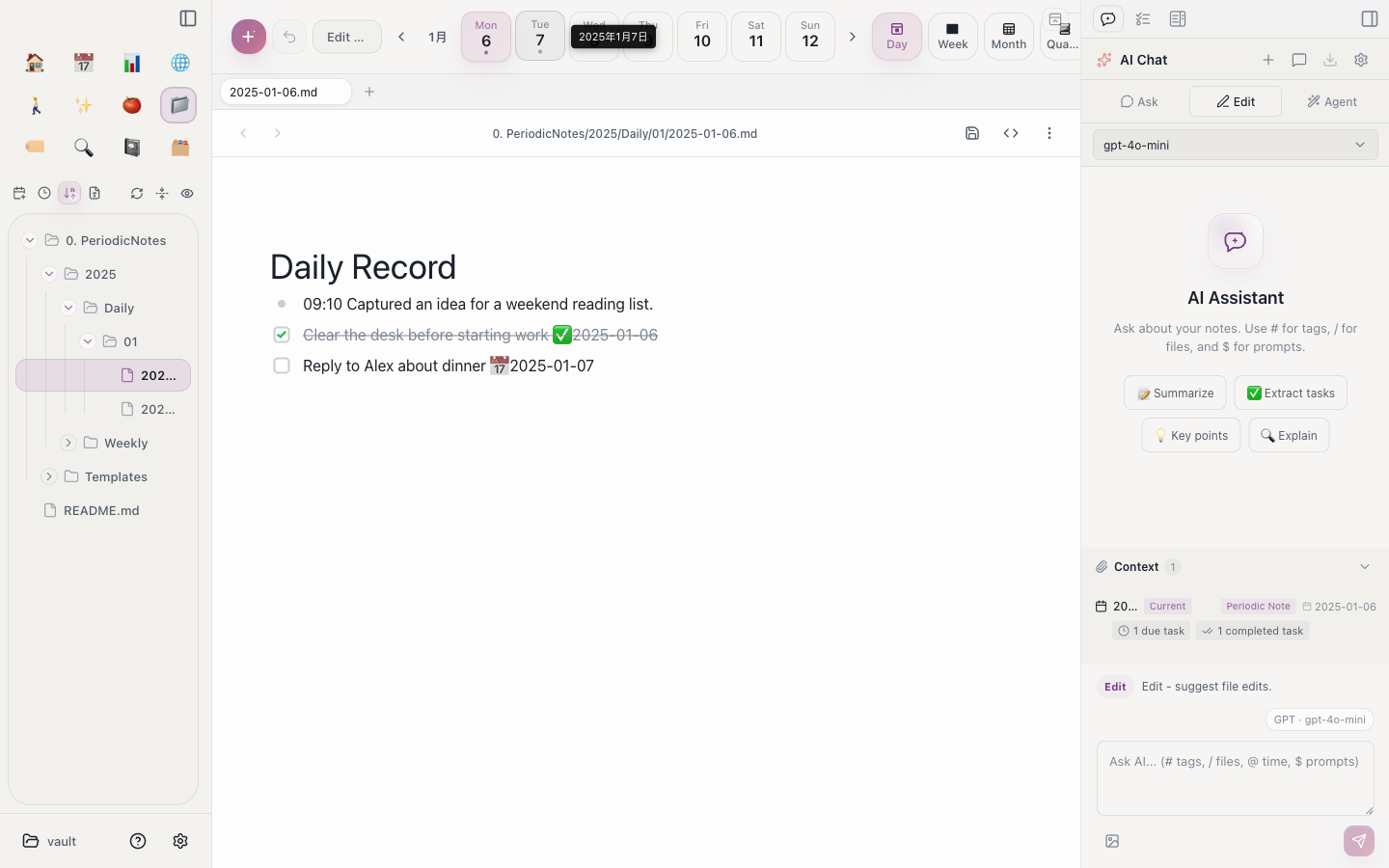
LifeOS Pro Memos Vaultalso includes2025-01-06.md,2025-01-07.md, and2025-W02.mdto demonstrate bullets, open tasks, completed tasks, and periodic review.- Write
- one noteor- [ ] one taskdirectly under that heading. - Weekly, monthly, quarterly, and yearly notes query tasks due in the period, recorded tasks, recorded bullets, and completed tasks.
- The templates contain no
ProjectListByTime,AreaListByTime, or theme snapshots.
Start using it
- Click Aino's bottom-left folder icon and choose "Open Existing Vault".
- Open
LifeOS Pro Memos Vaultinside the complete package'sLifeOS Pro/Example Vault/folder. - Open
0. PeriodicNotes/2025/Daily/01/2025-01-06.mdand2025-01-07.mdto see bullets, open tasks, and completed tasks in one section. - Open
0. PeriodicNotes/2025/Weekly/2025-W02.mdto inspect the record queries and sample review. - When you finish learning, use the bottom-left folder icon to open
LifeOS Pro Memos Blank Vault, then click "Today's Daily Note" to begin your own records.
Do not clear the example vault. LifeOS Pro Memos Blank Vault keeps the same settings and daily-to-yearly templates without sample date folders, so it is ready to become your main vault.
When should you upgrade?
Stay with Memos while time-based retrieval is enough. Upgrade only when a real new problem appears:
The table runs from IPO through OPC in increasing complexity. Do not upgrade for hypothetical future complexity. Structure is useful only when it removes a real retrieval or execution problem.
Upgrade from Memos
Old daily notes do not need to move when upgrading to IPO, GTD, or PARA:
- Back up the whole vault.
- Keep the current periodic-note folder, date folders, and custom templates.
- Explore the target filled example and confirm it solves your problem.
- Add the required folders and templates from the target Blank Vault; never
overwrite the whole
.lifeos/settings.json. - Enable the target capability in Aino and verify every path. PARA enables PARA and theme notes; IPO and GTD use theme notes with their own structures.
- Use the new model for new material first. Move or tag old records only when doing so creates real retrieval value.
Existing - [ ] and - [x] Markdown tasks continue to appear in task and review
queries. Upgrading does not rewrite them.
OPC contains more folders, dashboards, and agent files, and its periodic-note
path may differ. Start with OPC LifeOS Blank Vault, then copy the daily notes
and operating material you actually need.
Can you switch back or move again?
Yes, through migration—not as a cost-free toggle:
- To return to Memos, stop using or disable the taxonomy but keep old folders.
- IPO, GTD, and PARA conversions require each item's meaning to be reconsidered; migrate in reviewed batches instead of renaming the whole tree.
- Keep the old templates and settings backup until new daily notes, task queries, and links have been verified.
Next
- Periodic Notes — understand the daily-to-yearly time hierarchy.
- Task Management — see all
- [ ]tasks together. - Usage — compare Memos, IPO, GTD, PARA, and OPC from easiest to hardest.
Start with Aino
Turn this approach into your everyday workflow
Try Aino Desktop Pro free for 7 days, open an existing Markdown vault, or start with the complete example vault from your email.
- 7-day free trial
- Portable Markdown
- Complete example vault by email