
Open the Example Vault
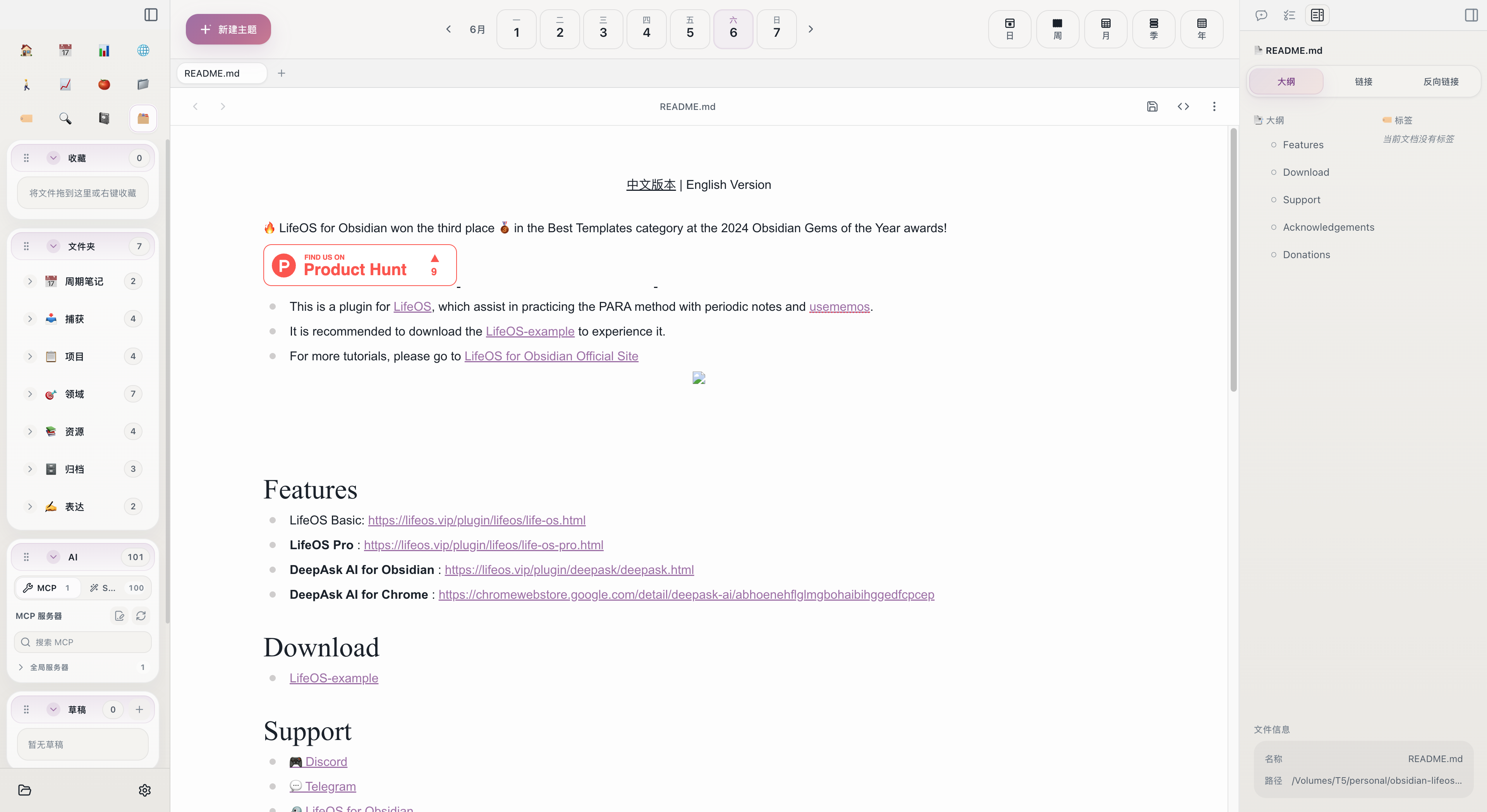
The filled example vault is the best entry point for new users. It is not a blank folder; it already contains notes, folders, templates, and settings. After learning from it, open the matching blank vault as your own main vault.
Open it first to see how Aino connects daily notes, tasks, projects, areas, resources, calendar views, and reviews. If your first need is next-action and follow-up management, you can start from the GTD example vault instead. If you already run a product, side business, consulting service, or content business, try OPC LifeOS.
Download the example vault
Download and extract the complete LifeOS Pro package:
After extraction, enter LifeOS Pro/Example Vault/. It contains exactly five filled examples, from easiest to hardest: LifeOS Pro Memos Vault, LifeOS Pro IPO Vault, LifeOS Pro GTD Vault, LifeOS Pro PARA Vault, and OPC LifeOS Vault. Aino must open one of these specific folders, not Example Vault or a parent directory.
Beside them are five matching blank vaults: LifeOS Pro Memos Blank Vault, LifeOS Pro IPO Blank Vault, LifeOS Pro GTD Blank Vault, LifeOS Pro PARA Blank Vault, and OPC LifeOS Blank Vault. Learn in the filled vault, then start your real work in its Blank Vault.
If you receive a separate example bundle, choose the specific vault folder inside it. The example vault already includes .lifeos/settings.json, so it can be used directly as an Aino example vault.
PARA, IPO, GTD, OPC, or Memos?
Choose by your current bottleneck: start with Memos if daily capture is not yet stable, or PARA if projects, ongoing responsibilities, and reusable knowledge already need structure.
The default easiest-to-hardest order is Memos -> IPO -> GTD -> PARA -> OPC. Choose Memos when the first goal is a stable daily capture habit; IPO when a few categories should turn sources into outputs; GTD for scattered tasks and waiting-for items; and PARA when projects, responsibilities, and knowledge all need structure. If you already have revenue, leads, customers, product, or delivery pressure, read OPC LifeOS Quick Start. This is not a mandatory sequence; skip directly to the matching template when the need is clear.
Open it in Aino LifeOS
- Launch Aino LifeOS
- Click the folder icon in the bottom-left corner
- Choose "Open Existing Vault" from the vault menu
- Enter the extracted
LifeOS Pro/Example Vault/folder - Select the specific example you want to practice with, such as
LifeOS Pro PARA VaultorLifeOS Pro GTD Vault - Wait for the file tree and index to load
You do not need to configure an AI key or connect a calendar first. You can start writing notes and managing tasks immediately.
Why does it work out of the box?
The example vault includes two important hidden folders:
.lifeos/settings.json does not contain accounts, activation codes, API keys, or calendar passwords. It only tells Aino where the project folder is, where the daily note templates are, and which sections should be indexed. The GTD vault also configures inbox, project, and review paths for action management.
Example vault structure
The PARA vault contains these folders:
Each PARA folder contains a Template.md. 0. PeriodicNotes/Templates/ contains daily, weekly, monthly, quarterly, and yearly templates.
The GTD vault contains these folders:
GTD task-state tags include #gtd/next, #gtd/waiting, and #gtd/someday. Context tags include #ctx/deep-work, #ctx/computer, #ctx/call, and more.
What should I do first?
Explore in this order:
- Open the daily note: click "Today's Daily Note" and see where daily capture starts
- Write a task: add
- [ ] Try Aino LifeOSin the daily note, then confirm it appears in the task panel - Open a project: open any project under
1. Projects/and see how project notes collect tasks and records - Open a weekly note: see how weekly planning and review connect
- Open resources: open
3. Resources/and see how references are preserved over time
If you opened the GTD vault, explore in this order: 1. Inbox/Inbox → 2. Actions/Next Actions → the sample project under 3. Projects/ → 5. Reviews/Weekly Review.
Do not rename the folders on your first pass. The example vault's .lifeos settings match the current folder names. Customize the structure later in your own vault.
Common questions
Aino did not recognize projects or daily notes
You probably selected the wrong folder. Make sure you opened a specific example vault, such as LifeOS Pro PARA Vault or LifeOS Pro GTD Vault, and that it contains .lifeos, .obsidian, and the expected workflow folders.
I cannot see .lifeos or .obsidian
They are hidden folders. On macOS Finder, press Command + Shift + . to show hidden files. On Windows, enable "Hidden items" in File Explorer.
Can I turn the example vault into my own vault?
You do not need to erase the example. Open its matching Blank Vault, which keeps only settings, folder skeletons, templates, and essential query pages. Keep the filled vault as a learning reference.
I only want Logseq, flomo, or usememos-style continuous capture
Open LifeOS Pro Memos Vault first and inspect its two sample daily notes plus the 2025-W02.md weekly review. PARA and theme notes are disabled by default. After learning how bullets, tasks, and review queries work, open LifeOS Pro Memos Blank Vault for your own records.
Related
- Getting Started — follow the beginner path
- Usage — choose between the example vault, an existing vault, and migration
- Core Concepts — understand the two LifeOS note systems
- Theme Notes — learn the PARA organization method
- Migrating from Obsidian — move an existing LifeOS for Obsidian vault into Aino
Start with Aino
Turn this approach into your everyday workflow
Try Aino Desktop Pro free for 7 days, open an existing Markdown vault, or start with the complete example vault from your email.
- 7-day free trial
- Portable Markdown
- Complete example vault by email